Can ML predictors detect mislabeled amyloids? 🧠🧬
amyloid, AmyloGram, machine learning, bioinformatics, IR spectroscopy, AFM, weak supervision
📌 Project highlights
- 🧬 Tests robustness of amyloid prediction tools
- ⚠️ Investigates mislabeled experimental datasets
- 🤖 AmyloGram successfully identifies annotation errors
- 🔬 Combines ML with IR spectroscopy & AFM validation
- 🧠 Demonstrates resilience to weak supervision
🎉 New paper out!
What happens when the training data itself is wrong? 😅
🔗 Paper links
🎧 Audio summary
Machine learning models are only as good as their training data… right? 🤔
But what if:
- experiments disagree,
- databases contain annotation errors,
- and the model was trained on mislabeled sequences?
This paper tested exactly that.
🔬 What is this about?
Amyloid aggregation is central to diseases such as:
- Alzheimer’s disease
- Parkinson’s disease
- systemic amyloidoses
But identifying whether a peptide is amyloidogenic is difficult.
Researchers typically rely on:
- 🔬 AFM or electron microscopy
- 🌈 Thioflavin T staining
- 📈 infrared spectroscopy (IR)
The problem?
👉 these methods do not always agree.
Especially for:
- oligomers,
- transient aggregates,
- partially aggregated peptides.
This can produce:
❌ mislabeled databases
❌ noisy training sets
❌ weak supervision problems
🤖 The core question
Can machine learning models:
👉 detect errors in their own training data?
That’s a very dangerous test for overfitting 😄
🧠 What we tested
The study analyzed:
- AmyloGram
- PATH
- FoldAmyloid
- PASTA 2.0
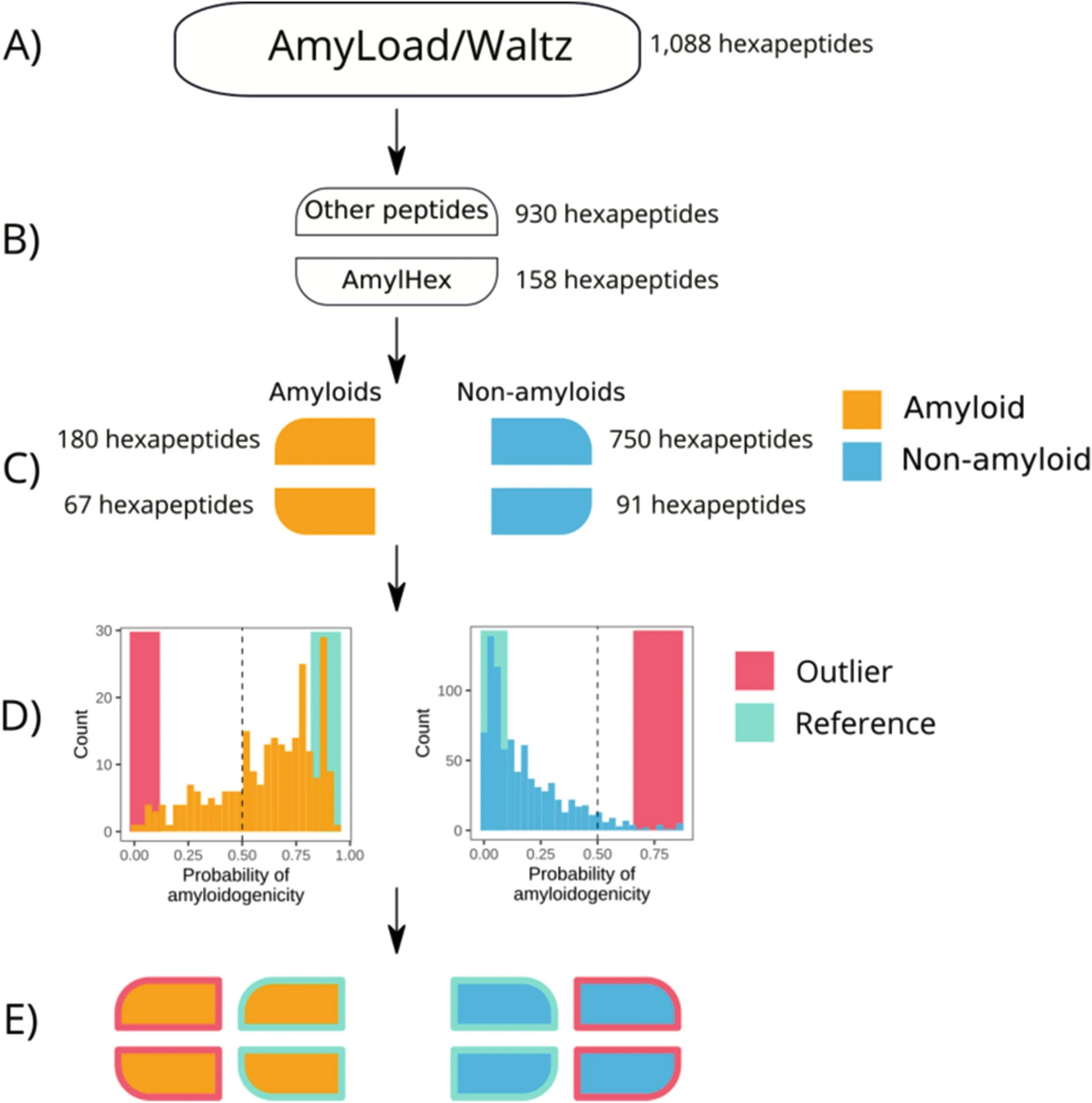
We have selected:
- peptides strongly agreeing with database labels ✅
- peptides strongly disagreeing with database labels ❌
and then re-tested them experimentally.
🔬 Experimental validation
To verify peptide behavior, the team used:
🧪 IR spectroscopy
Two complementary IR methods:
- ATR-FTIR
- IR microscopy
🔬 Atomic Force Microscopy (AFM)
Used for direct visualization of aggregates and fibrils.
🧬 The cool part: oligomers
The paper highlights something very important:
👉 amyloid prediction is NOT binary.
There are at least 3 experimentally relevant classes:
- non-amyloid
- oligomer
- mature amyloid fibril
And oligomers are especially tricky because:
- they are often highly toxic,
- experimentally unstable,
- difficult to classify.
📊 Key results
⚠️ Massive misannotation discovered
Among 24 experimentally tested “outlier” peptides:
- 17 were actually misannotated in databases
That means:
👉 the ML model was often RIGHT
👉 the database labels were WRONG 😅
🤖 AmyloGram resisted overfitting
Even though those mislabeled peptides were:
👉 already present in the training set,
AmyloGram still identified many as suspicious.
This is a huge result.
It suggests:
🧠 ML models can sometimes act as quality-control filters for biological databases.
📈 Spectroscopy + PCA worked beautifully
The paper also used:
- principal component analysis (PCA)
- on IR spectra
to separate:
- amyloids
- non-amyloids
- ambiguous oligomers
🔬 Experimental insights
🧪 IR microscopy outperformed ATR-FTIR
The authors conclude that:
👉 IR microscopy was generally more reliable
because ATR-FTIR could be influenced by:
- water interactions
- sample thickness
- surface effects
🧬 Oligomers complicate annotations
Some sequences behaved differently depending on the method used.
Example:
- SFLIFL formed oligomers but not mature fibrils
This explains why database labels may become inconsistent.
🧠 Why this matters
📚 For machine learning
This paper is a great example of:
👉 weak supervision in biology.
The training labels are not absolute truth.
🔬 For amyloid research
It shows that:
- experimental methods have biases
- annotation errors are common
- computational tools can help detect inconsistencies
🚀 For bioinformatics pipelines
The work suggests that prediction tools can serve as:
- classifiers
- benchmarkers
- and dataset-cleaning systems
💚 BioGenies perspective
This paper quietly delivers a very deep message:
👉 biological databases are messy.
And sometimes:
🤖 the model understands the biology better than the labels.